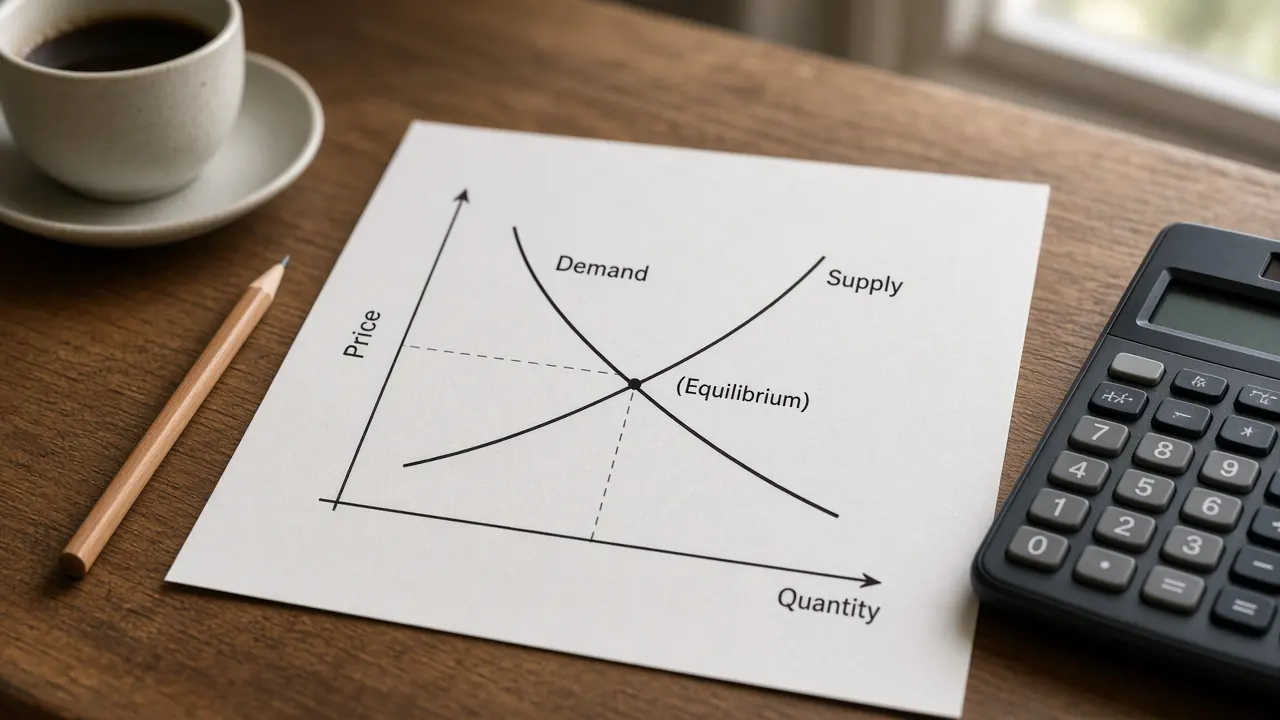
Every market you meet (groceries, housing, labour, foreign exchange) rests on a simple tension: how much people want to buy at a given price, and how much sellers are willing to offer. When those plans match, a market clears. When they do not, prices and quantities tend to adjust until they do, unless rules, costs, or frictions get in the way.
Demand: willingness and ability to buy
Demand is not the same as desire. It is the schedule of quantities buyers are prepared to purchase at different prices, given incomes, tastes, and the prices of related goods. Holding other things equal, a lower price usually means a higher quantity demanded. That is the familiar downward slope of the demand curve.
Shifts in demand happen when something other than the good’s own price changes. A rise in household income can lift demand for many services. A colder winter can raise demand for heating fuel. A substitute becoming cheaper can pull demand away. In both the UK and the US, housing demand also reflects credit conditions and demographics, factors that sit outside a simple textbook diagram but still move the curve.
Supply: willingness and ability to sell
Supply describes how much producers are willing to sell at different prices. Higher prices typically draw forth more output, because they cover higher marginal costs or attract new entrants. Costs of inputs, technology, regulation, and expectations about the future all shift supply.
Energy markets illustrate this vividly. When input costs jump, supply curves shift left: the same quantity requires a higher price, or the same price supports less quantity. Agricultural seasons, port capacity, and labour shortages can do the same in other markets.
Equilibrium, shortages, and surpluses
Where supply and demand cross, the market has a candidate equilibrium price and quantity. If the price is held below that level (by a binding rent control or a temporary freeze), quantity demanded exceeds quantity supplied: a shortage. Queues, waiting lists, or informal markets often appear. If the price is held above equilibrium, surplus inventory or unused capacity can build up.
Prices are signals and incentives at once. They ration scarce goods and tell producers where effort is valued.
The supply and demand equilibrium calculator solves a straight demand line and a straight supply line for the price and quantity where they meet. A second mode uses a price you type and reports the shortage or the surplus. You type the numbers. The tool runs in your browser. It is educational only, and it is not advice about price controls.
Elasticities: how strongly quantities respond
Elasticity measures how responsive quantity is to price (or income). Petrol demand in the short run is often relatively inelastic: people still need to travel. Demand for a particular restaurant meal is usually more elastic. On the supply side, capacity that takes years to build (power plants, housing) responds slowly; soft goods can respond faster.
Policy debates in Westminster and Washington often turn on elasticities without using the word. A tax on a good with inelastic demand tends to raise more revenue and change behaviour less; a subsidy for something elastic can expand quantity a lot relative to its budget cost.
Reading headlines with this lens
When you see “prices surge,” ask whether demand shifted out, supply shifted in, or both. Pandemic-era goods shortages mixed factory shutdowns (supply) with spending redirected from services to durables (demand). Energy price spikes after geopolitical shocks were largely supply-side at first, then fed into broader inflation measures tracked by the ONS in the UK and the BLS in the US.
For definitions of related terms such as equilibrium, elasticity, and price level, see the glossary. Next, you may want inflation (what happens when the overall price level keeps rising) or GDP, which aggregates the quantities produced across markets.
Price and quantity are the axes for one market. The whole economy uses a price level and real GDP. That graph is the aggregate demand and aggregate supply model.
Sources
- ONS: Prices (for applied price shocks)
- BLS: CPI (price measurement context)
- IMF Finance & Development: Back to Basics
- World Bank: Macroeconomics
Next: inflation, explainers.