A real interest rate is the nominal interest rate minus inflation, which is the Fisher approximation, while the exact one period formula divides one plus the nominal rate by one plus inflation and then subtracts one. The approximation is close when inflation is low, and the two answers separate when inflation is high. This page is educational only, and it is not investment advice.
The two formulas
A nominal interest rate is the rate quoted on a loan, a savings account, or a government bill. A real interest rate asks what that quote means for purchasing power. Irving Fisher treated the nominal rate as a real return plus compensation for inflation. In the classroom the link is an identity, before risk, tax, and fees.
Approximate real rate = nominal rate minus inflation rate.
Exact real rate = (1 + nominal rate) divided by (1 + inflation rate), then minus 1.
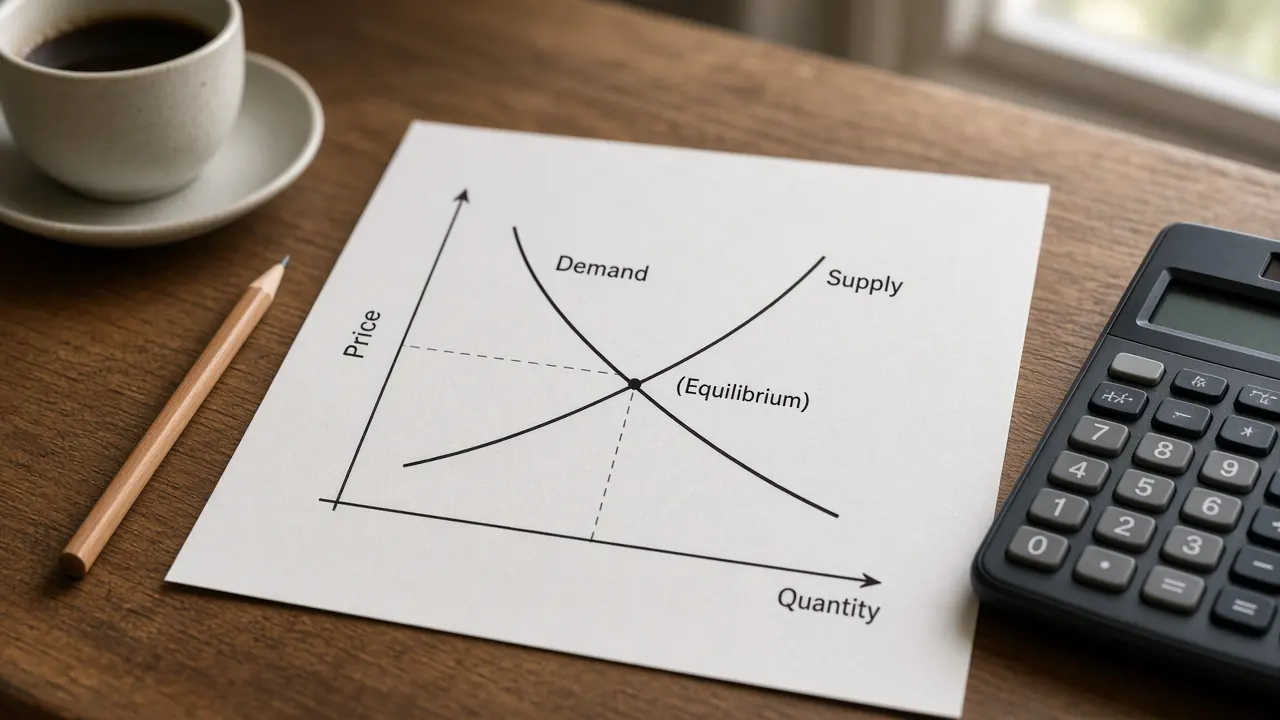
Use decimals inside the exact formula. A quoted rate of 4 percent is 0.04, so one plus the nominal rate is 1.04. The approximation is the shortcut people use in conversation. The exact formula is the change in purchasing power over one period. The glossary entry is the short definition. The classroom graph for the real rate, set next to the money market graph for the nominal rate, is the money market and the loanable funds market. The rest of this page is about which inflation rate you subtract, and where a real yield is quoted directly.
A worked example
Take a savings account that pays 4 percent while prices rise 2 percent. The approximation is 4 minus 2, so 2 percent. The exact formula is 1.04 divided by 1.02, then minus 1, which equals 1.96 percent. The shortcut sits 0.04 percentage points above the exact answer.
The same steps at high inflation pull apart. A nominal rate of 25 percent and inflation of 20 percent give an approximation of 5 percent. The exact formula is 1.25 divided by 1.20, then minus 1, which equals 4.17 percent. The shortcut sits 0.83 percentage points above the exact answer. That gap equals the approximate real rate, multiplied by inflation, then divided by one plus inflation. It stays small when inflation is a few percent. It grows when inflation is large.
Every row is classroom arithmetic. None of these rates is Bank Rate, a mortgage offer, or a savings account you can open. The gap column is the approximation minus the exact real rate, in percentage points.
| Case | Nominal rate | Inflation | Approximation | Exact formula | Gap |
|---|---|---|---|---|---|
| Savings account | 4 percent | 2 percent | 2.00 percent | 1.96 percent | 0.04 percentage points |
| Mortgage | 6 percent | 3 percent | 3.00 percent | 2.91 percent | 0.09 percentage points |
| Policy rate | 4 percent | 3 percent | 1.00 percent | 0.97 percent | 0.03 percentage points |
| High inflation case | 25 percent | 20 percent | 5.00 percent | 4.17 percent | 0.83 percentage points |
Type any other pair into the real interest rate calculator. A live UK policy comparison, using published Bank Rate and CPI, is in the market section below. It is not one of these rows. The inflation adjuster does the related sum for a cash balance rather than for an interest rate.
Ex ante and ex post
Ex post uses inflation that has already been published. It answers what a saver or a borrower actually earned or paid, in goods, after prices moved. Ex ante uses expected inflation. It answers what real return someone thinks they are agreeing to before the period is over. Policy decisions are mostly about the ex ante question, even though expectations are harder to see than a statistical release.
The same contract can give both answers. A one year deposit pays 4 percent. If you expect inflation of 2 percent, the approximate ex ante real rate is 2 percent, and the exact ex ante result is 1.96 percent. If inflation then comes in at 5 percent, the approximate ex post real rate is minus 1 percent. The exact ex post result is 1.04 divided by 1.05, then minus 1, which equals minus 0.95 percent. The surprise is the story. The formula gap is small next to it.
Which inflation index you name is part of the answer. Past CPI, past CPIH, an expected CPI path, and a market inflation compensation figure are different inputs. Core versus headline inflation is about what a price index leaves out. CPI versus PCE is about why the UK and US consumer baskets are not the same object.
Real yields you can read in the market
You do not have to subtract. Some government bonds pay a real coupon, so the yield is already a real yield, plus premia for liquidity and for risk. In the United States those bonds are Treasury inflation protected securities, usually called TIPS. The Treasury publishes a par real yield curve from that market. In the United Kingdom the cousins are index linked gilts, and the Bank of England fits an implied real spot curve to their prices. Neither quote is a forecast, and neither is advice to buy or sell.
| Reading | Figure | As of | What it is |
|---|---|---|---|
| US 10 year real par yield | 2.91 percent | 6 October 2026 | Treasury par real yield curve, from TIPS. The 5 year point that day was 2.66 percent and the 30 year point was 3.35 percent. |
| US 10 year nominal par yield | 5.27 percent | 6 October 2026 | Treasury par yield curve. Nominal minus real on this row is 2.36 percentage points of inflation compensation, not a pure inflation forecast. |
| Cleveland Fed 10 year expected inflation | 2.57 percent | Model output 1 September 2026, posted 11 September 2026 | A model estimate. The page listed its next update as 14 October 2026. Inputs include Treasury yields, inflation, inflation swaps, and surveys. |
| Cleveland Fed 10 year real rate | 2.24 percent | Same model output date | The model real rate in that release, rounded to two decimal places. FRED series REAINTRATREARAT10Y is the public series for this estimate. It is not a TIPS yield. |
| UK 10 year implied real spot rate | 1.996 percent | 30 September 2026 | Bank of England implied real spot curve, fitted to index linked gilts. The main spot curve in that daily file starts at 2.5 years. |
| UK Bank Rate | 3.75 percent | Held in the decision published 17 September 2026. Next decision due 5 November 2026. | The nominal policy rate. Not a real rate until you choose an inflation measure. |
| UK CPI | 3.1 percent | 12 months to August 2026 | ONS consumer price inflation. This is the index in the 2 percent Bank of England target. |
| UK CPIH | 3.3 percent | 12 months to August 2026 | ONS CPIH, which includes owner occupier housing costs. The 12 month rate was up from 3.1 percent the previous month. |
| US effective federal funds rate | 3.88 percent | 5 October 2026 | New York Fed. The target range published with that rate was 3.75 to 4.00 percent. This row is nominal. |
Pair Bank Rate of 3.75 percent with CPI of 3.1 percent and the approximate ex post gap is 0.65 percentage points. The exact formula is 1.0375 divided by 1.031, then minus 1, which equals 0.63 percent. Swap in CPIH of 3.3 percent and the approximation falls to 0.45 percentage points, while the exact formula gives 0.44 percent. At these levels, naming CPI or CPIH moves the answer by more than the choice between the two formulas. The sketch still mixes an overnight policy rate with inflation over the previous 12 months. It is not the 10 year gilt real yield, and it does not say whether policy is tight.
The US funds rate needs the same care. This page does not subtract a US inflation rate from 3.88 percent, because CPI and PCE answer different questions. Open the current BLS or BEA release, then enter the rate you chose in the calculator. FRED series DFII10 is the constant maturity 10 year TIPS yield. It tracks the same market as the Treasury real par yield, and the two quotes are not the same cell. Read DFII10 on FRED for that series. The Cleveland Fed model real rate of 2.24 percent and the Treasury real par yield of 2.91 percent are different objects on different dates. The Cleveland Fed charts model real rates against TIPS yields because a TIPS yield also contains premia the model tries to split out.
Why the real rate changes the story
Suppose Bank Rate or the federal funds rate rises by two percentage points, and expected inflation rises by the same amount. The approximate real policy rate is unchanged. Suppose instead that the nominal rate stays put while inflation falls. The real rate rises, and conditions tighten, with no headline increase. Households meet the real rate in mortgage payments and savings relative to prices and wages. Firms meet it as a real cost of funds relative to real revenues. Governments meet it in debt service relative to taxes that also move with prices and real activity.
A higher nominal rate is not automatically tight if inflation, and expected inflation, are higher still.
The neutral real rate, or r star
r star is a real rate thought to be consistent with inflation near target and with the economy at potential, once temporary shocks have faded. If the real policy rate sits well above estimates of r star, the usual reading is that policy is restrictive. If it sits well below, the usual reading is that policy is easy. Estimates drift with productivity, demographics, and the balance of global saving and investment, and they get revised. r star is not a release in the way CPI is. This page does not print an r star level.
The Taylor rule is one classroom way to turn r star, an inflation goal, and an output gap into a suggested nominal policy rate. The Taylor rule calculator runs that arithmetic on numbers you type. The output gap is the activity piece, not a real interest rate. The natural rate of unemployment is a different natural rate again. It is about the job market, not about the real price of funds. Nothing here recommends a policy setting or a portfolio.
Savers, borrowers, and cash
Cash and current accounts that pay no interest have a real return of about minus the inflation rate. That is an inflation tax on idle balances. A deposit compensates only if its nominal rate clears expected inflation, and any extra yield is there for credit risk or for tying the money up. Periods of negative ex post real policy rates are painful for savers who want safety, even when the headline nominal rate looks ordinary next to older decades.
Borrowers who owe a fixed nominal sum gain when inflation comes in higher than expected, because the repayment buys fewer goods, unless their incomes fail to keep up or the interest rate resets. Many UK mortgages reset when Bank Rate changes. Many US mortgages keep the same nominal rate for a long stretch. That difference belongs in any UK and US comparison of how a real rate is felt. It is not advice about which mortgage to choose.
Short rates, long rates, and the curve
Policy rates are overnight or very short. Households and firms often borrow for years. The real policy rate can move while longer real yields move less, or more, because expected growth, term premia, and quantitative easing (or the later reversal of those purchases) sit in the longer yield. Looking only at the overnight real rate can misstate the cost of a long mortgage or a corporate bond.
The yield curve is the nominal map across maturities, for Treasuries in the United States and gilts in the United Kingdom. The yield curve spread calculator is the arithmetic for a gap you type. When expected inflation falls, nominal yields can fall even if real yields hold still. Splitting a move into a real piece and an inflation compensation piece, using indexed bonds or inflation swaps, is how those two stories stay separate.
UK and US lenses
UK readers usually set Bank Rate next to CPI or CPIH from the ONS, and they watch the real curve fitted to index linked gilts. The Bank of England target is 2 percent on CPI. US readers usually set the federal funds rate next to CPI from the BLS or PCE from the BEA, and they watch TIPS yields. The Federal Reserve states a longer run goal of 2 percent on PCE. A real rate built on one basket is not a fact about the other country.
Country context sits on the United Kingdom and United States pages. The wider map is the inflation topic and the monetary and fiscal policy topic. The data guides are about how to read a release, not a substitute for the release. Open the dated source before you treat any figure on this page as still the latest print.
Common questions
Can real interest rates be negative?
Yes. The real rate is negative when inflation is higher than the nominal rate. Cash that pays no interest then loses purchasing power at about the pace of inflation. A quoted rate of 3 percent does not protect purchasing power if prices rise by 5 percent. On 6 October 2026 the 10 year US Treasury real par yield was positive, at 2.91 percent, so a negative real yield is possible without being a description of that quote. This is arithmetic, not a forecast, and it is not investment advice.
Why do real rates matter more than nominal rates?
Spending, saving, and the burden of a debt depend on purchasing power, not only on the number printed on a contract. If the nominal policy rate rises by two percentage points and expected inflation rises by the same amount, the approximate real rate does not change. If the nominal rate stays put while inflation falls, the real rate rises and financial conditions tighten with no headline increase. A higher nominal rate is not automatically tight policy.
What is the Fisher equation?
The Fisher equation is the classroom identity linking a nominal interest rate, a real interest rate, and inflation. One plus the nominal rate equals one plus the real rate, multiplied by one plus inflation. Rearranged, the real rate equals one plus the nominal rate, divided by one plus inflation, then minus one. A common approximation adds the real rate and inflation to get the nominal rate, which is the same statement as real rate equals nominal rate minus inflation. The approximation drops a cross term, so it is less accurate when inflation is high.
How do I calculate the real interest rate?
Subtract the inflation rate from the nominal rate for a fast answer. For the exact one period answer, turn both rates into decimals, divide one plus the nominal rate by one plus the inflation rate, and then subtract one. A nominal rate of 4 percent with inflation of 2 percent is an approximate real rate of 2 percent, and an exact real rate of 1.96 percent, because 1.04 divided by 1.02, then minus 1, equals 1.96 percent. Say whether your inflation input is past inflation or expected inflation. The calculator on this site shows both results from numbers you type. It does not look up a live rate, and it is not investment advice.
What is r star?
r star is an estimate of the real interest rate consistent with inflation near target when the economy is at potential and temporary shocks have faded. If a real policy rate sits well above estimates of r star, the usual reading is that policy is restrictive. If it sits well below, the usual reading is that policy is easy. Estimates move with productivity, demographics, and the balance of saving and investment, and researchers revise them. r star is not a statistical release in the way CPI is. A separate page on the Taylor rule shows one classroom formula that starts from r star. Nothing on this page recommends a policy setting.
What is the difference between an ex ante and an ex post real rate?
An ex ante real rate uses expected inflation. It is the real return you think you are agreeing to before prices move. An ex post real rate uses inflation that has already been published. It is the real return after the fact. A deposit that pays 4 percent, when you expect inflation of 2 percent, has an approximate ex ante real rate of 2 percent. If inflation then comes in at 5 percent, the approximate ex post real rate is minus 1 percent, and the exact one period result is minus 0.95 percent. Policy talk is mostly about the ex ante question. A price index answers the ex post question, and only for the basket it measures.
Sources
- US Treasury, Daily Treasury Par Real Yield Curve Rates
- US Treasury, Daily Treasury Par Yield Curve Rates
- FRED, 10 year constant maturity TIPS yield (DFII10)
- FRED, 10 year real interest rate (REAINTRATREARAT10Y)
- Federal Reserve Bank of Cleveland, Inflation expectations
- Federal Reserve Bank of Cleveland, inflation expectations model spreadsheet
- Federal Reserve Bank of New York, Effective Federal Funds Rate
- Federal Reserve, FOMC
- Bank of England, Bank Rate
- Bank of England, Yield curves
- ONS, Consumer price inflation, UK, August 2026
- BLS, Consumer Price Index
- BEA, Personal consumption expenditures price index